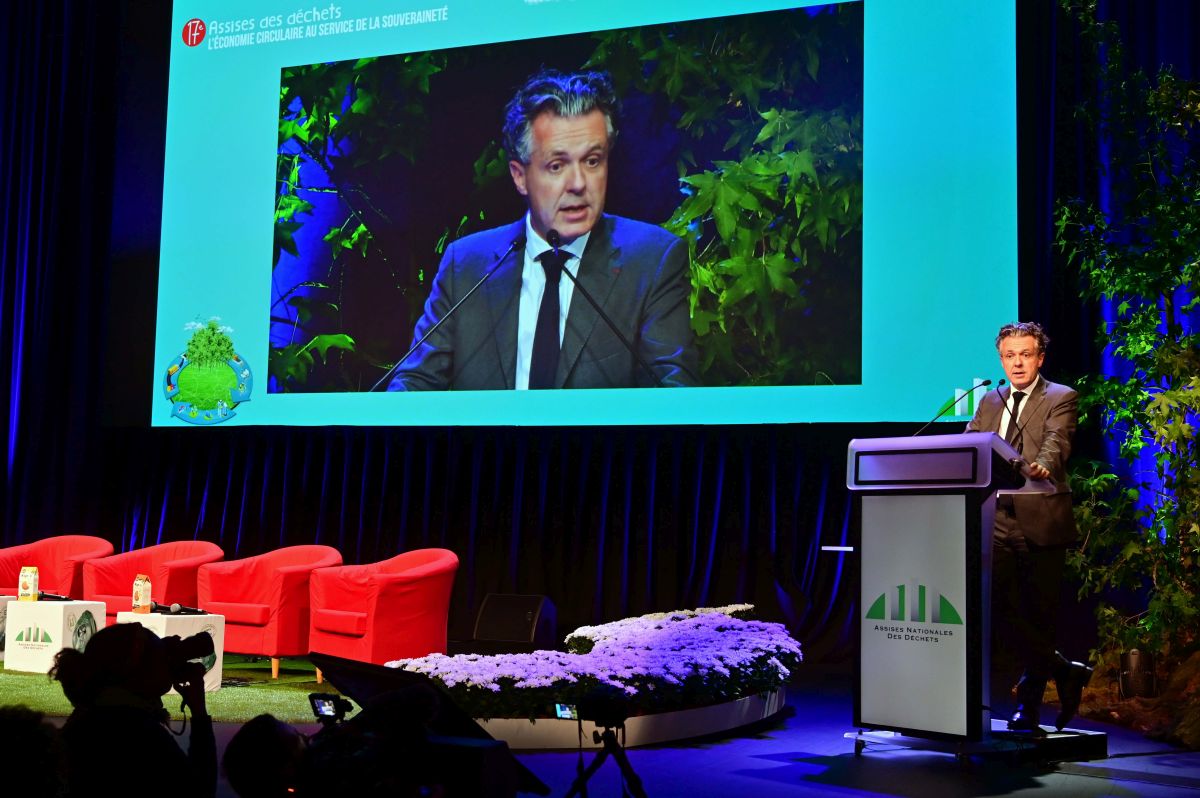
Sustainable Development and Integration Director, European Commission
Good morning Ladies and Gentlemen,
I am very happy to be here with you at this essential conference.
In the environmental field, the waste policy plays a crucial role. The European environmental policy also is very significant, all the more when it concerns climatic change, economic and environmental choices and waste policy and management.
First of all, the environmental impact is tremendous : from now on it is catastrophic like Ivory Coast incidents that happened a year ago. It also is important because the economic impact is always more vital, waste management is close from our daily concerns.
very day we are faced to the challenge of waste management and this is the reason why it has become important.
The European policy is in the field very complex : there are more than 30 different rules because the subject itself is difficult to deal with.
I will try to give you a snapshot of the past, present and future of EU European environmental policies. I raised a few issues with my short presentation that I believe are important for you to understand, particularly - as already promised - to touch the revision of the waste framework directive, but not only. I will raise a few other future issues as well.
Indeed, the waste policy of the European Union is already modern. Thirty years ago, the first law was decided - framework directive - already in 1975. Of course, the world has changed quite a lot since those days. Thirty years ago, the waste was an environmental problem, a nuisance for us that had to be dealt with. Of course with some amount of money for households, industries and municipalities, the problem was dealt with. The main objective was really to get rid of it, to get it out of our sight somewhere. People didn’t care where it went; usually it went to the landfills.
That was the situation 30 years ago, because the world has changed a lot since those days. First of all, today the volumes of waste have increased enormously. They are still increasing in Europe particularly and globally. Waste issues have become, from being local or regional issues - and they still are - into European and global issues. So we cannot deal with the waste only locally because there are so many linkages to issues up to the global challenges. Then the business around the waste management has increased enormously and is actually in process of increasing further. I would argue that the business is about to flourish and is going to flourish in the future in this area. I will come back to this issue later. And of course, we do have these more than thirty pieces of legislation that we also need to manage now at the European level. This is very complex. Certainly something needs to be done to that.
My institution, my team in the European Commission, are prepared to respond to these new challenges - very important stages as we call them "Thematic Strategies", overall strategies, - on waste and on the use of natural resources, which were published early 2006. As a first concrete measure to implement those strategies, we proposed a revision of the waste framework directive to move forward to the waste policies, to respond - if you like - to the changing environment.
Our objective, the Commission’s objective, was the following: with this proposal, we wanted to modernise the waste legislation. First of all, we wanted to move from the perception of the waste to what is a perception of natural resources. We wanted to bring the life cycle thinking into the waste policies; particularly when the priorities for the waste policies are being set. And we wanted to move towards products from the waste policies; in these words, the objective of this proposal is certainly not going yet all the way through. Our objective was also to clarify and simplify, particularly in the area of definitions. This turned out to be not an easy task.
We also wanted to move waste prevention into concrete actions of the talk. Volumes are increasing and there prevention is to give it the attention it deserves. But realising the limits of waste policies to address the waste prevention, one of the waste directors in Europe told me once that waste prevention for him, as a waste manager, is like sitting downstream under the waterfall and trying to shout up stream "stop the water running" without any control of the water coming downstream. I think this demonstrates the challenge of the waste policy but nevertheless, waste prevention needs an attention. Of course then, with a range of measures, we wanted to move towards European recycling society, arrange some measures in the legislation.
During the summer under the German presidency, the political agreement - first agreement among 27 Member States - was reached. Were these objectives then met with this political agreement? I would say quite well that they were met. Waste prevention programmes are now becoming a new element in the waste legislation, in the waste process. This means in practice that there should be a possibility to classify or declassify certain substances, not to be in waste anymore. This is becoming a feature of the waste framework directive. Furthermore definitions, some clarifications - perhaps not going as far as we would have wanted but nevertheless that is part of the political agreement - European standards for both waste treatment facilities and products, are part of the way forward. The Council found a very delicate and sensitive balance between different views on all of the waste hierarchy in the waste management. How to deal with the waste oil? We merge the waste oil directive into the waste framework directive.
Also on the biowaste issue: we are, for your information, working on further proposals and biowaste but those will come later next year. Of course now the next phase in the processes is to try to get an agreement in the European Parliament who took the view already earlier on - a radical view - on the proposal and then a compromise between the European Parliament and the Council. To my mind, the key issue to our analysis in these discussions between the Council and the Parliament will be to look at which role the binding targets play in the future framework directive, particularly in the areas of waste prevention and overall target for recycling.
My Commissioner feels very comfortable with this discussion. Perhaps we position ourselves at this date somewhere here in between. We would be ready to support any further targets and we would be also ready to support, for instance, separate collection of biowaste if that would be an agreement but here our "but" is the following: they need to be environmentally justified and also to be implementable and measurable. Otherwise, we will be running into big confusion if the clarity is not going to be there.
Well also, from our perspective, we would not be pleased if we saw further watering down of the scope of the waste directive. There was an attempt to get some things out from the definition of the waste because you can understand that then a lot of red tape issues and actions would not really concern those issues. Of course we would not want to see the watering down of the waste management plan. This is because of environmental reasons and this is what we are going to be clear about in our role in the conciliation.
This is what I thought to say about the waste framework directive but I am going to pick up a few more things about the future that is in your interest, to finish my introduction. First of all, we now put a lot of emphasis on the implementation. For instance, we need to talk about the targets. There are a lot of targets in the waste legislation; there already are the waste stream-based targets and implementing those targets is a very challenging task. A lot would be achieved if those targets are implemented; clock sticking, as you know there is always time for getting those in place.
In implementation we will, for environmental reasons, particularly focus on two pieces of legislation: landfill directive and waste shipment regulation. So they are in our focus and you will hear more about us when we try to advance with the implementation. Infringement cases in the waste sector - infringement is when the country doesn’t implement the legislation; we have a chance of taking the country to court – count for up to 10% of all European infringement cases, in any sector which is waste related. You can imagine that this is a big challenge. Waste treatment standards, over and above the waste incinerators, will be implemented through the vision of the IPPC directive. That is a licensing directive for industrial installations. We want to expand the scope to cover other waste treatment facilities as well;
For the review of the WEEE and RoHS electronic and electrical equipment legislation, which is still virtually new, a proposal from the Commission is going to come next year. Consultations are in full swing now. I just can tell you that our interest and objective will be to enhance the environment on economic benefits of that legislation and also remove implementation and enforcement problems that are built-in partially to the legislation. But there will be no rollback of this legislation because this certainly is benchmarking also globally as you all know.
On illegal shipments of waste, I already referred to the Ivory Coast (Côte d’Ivoire) incident about a year ago. I just want to draw your attention to the fact that a new revised waste shipment rule entered into the force on 1st of July of this year and imposes new obligations for enforcement authorities to tighten their enforcement. Some studies show that up to 50% - up to half - of all shipments of waste from Europe outside Europe are unaccounted for, illegal or not. Of course, this is too much and my Commissioner wants to do something about that.
We also have some signs that there are increase movements of waste from old Member States to new Member States. We are of course now analysing the situation and you can expect some measures in that area. A couple of more things that I would raise as a final issue for you to reflect upon are, first of all, the issues of ship dismantling. Of course when I came here, I saw the big shipyards on the way from Nantes to this place. The case of the Clemenceau about a year ago - not only that case but this case as well - trigged us to come up with a Green Paper proposal for the European strategy for ship dismantling.
Of course it tries to respond to the environment and health concerns raised about conditions of dismantling - particularly in the Far East - and then of course unfair competition also in that respect. The Green Paper is a discussion paper, a consultation paper and this will lead us to present a European strategy action plan next year and to work towards more stringent IMO (International Maritime Organization) global roles.
Finally, an important new step in the waste policy - and I refer to what I said earlier about moving upstream in the policy - is the consultation that we are now having on the future European action plan for sustainable proximate consumption, moving towards better products. The Chinese toy case demonstrates us the need to look at the quality of the products, moving to the roots of the problem and not trying to address them at the end of the pipe. To lean on a more efficient production in the European Union and also to look at the consumption, what we can do at the European level in terms of informing the consumers and making their choices clearer when they chose what they buy.
A range of actions have already been proposed in the discussion paper which is now in the interservice consultation. This certainly will also move waste and resource policies forward. So Mr. Chairman, I would perhaps just want to conclude my introduction by telling that this is certain at all. I mean I don’t have time to go in depth in many other issues but I just want to repeat that waste policies are an important part of European policies as perhaps you all feel.
They are important because we can reap further environmental benefits with the waste policies. They are important, as I already said, for economical reasons but above all they also give all our citizens the possibility to do something for the environment. According to our opinion polls for instance, housewives - I should not say housewives perhaps, housemen as well - would be willing to do more for the environment but they don’t really know what. In the waste sector, we need to make it easier for a citizen to do something because that is also important in the environment policies.
That’s why I think that your conference is extremely timely and important from the European and French waste policy perspectives. You are the ones who make things happen. Of course we can talk a lot but it is always more difficult to make things happen. That is why I wish every success to your conference.
Thank you.
Assises Nationales des Déchets - 2 rue Alfred Kastler BP 30723 - 44307 Nantes Cedex 3 France
Tel. 33 (0)2 51 85 80 99 - Fax 33 (0)2 51 85 80 44
|
|
| | Privacy policy | | | Contact us | | | Credits |